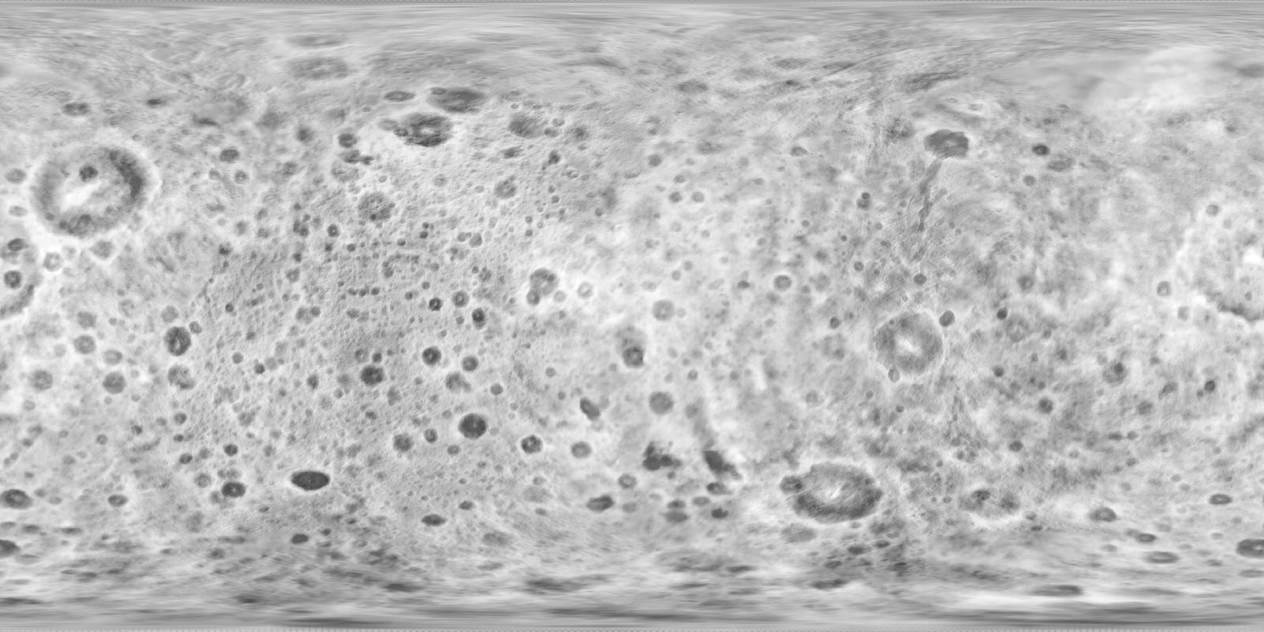

Saturn’s moon Rhea presents a fundamental puzzle in satellite evolution: despite negligible internal heat generation, no intrinsic magnetic field, and ancient heavily cratered surfaces indicating minimal recent activity, Rhea maintains an organized exosphere with anomalous O₂/CO₂ chemistry, exhibits surface hydrazine suggesting active material transport, displays fresh tectonic fractures, and survived an enormous impact (Tirawa crater, D/D_body ≈ 0.47) without catastrophic disruption. Traditional frameworks emphasizing internal energy sources cannot explain this moderate organizational capacity in an ostensibly inactive body.
We develop a quantitative framework for external field support in tidally locked satellites, calculating coherence density ρc—a dimensionless metric of organizational capacity—by combining internal generation with resonantly amplified external contributions from the host planet’s magnetosphere.
Applied to Rhea, the framework yields ρc,eff = 0.60 ± 0.05, representing ~120× resonant amplification of Saturn’s weak field at 8.74 planetary radii. This places Rhea between Mars (ρc = 0.237) and Earth (ρc = 1.0) in organizational spectrum, despite internal coherence near zero (ρc,int = 0.005). Critically, Rhea occupies a stable equilibrium band (dρc,eff/dr ≈ 0) satisfying bounded optimization principles with no energy creation, only efficient coupling. System-wide validation across seven major Saturn satellites shows perfect rank correlation (Spearman ρ = 1.0) between predicted ρc,eff and observed activity levels, with no per-moon adjustable parameters.
The framework distinguishes ocean-bearing from ice-only moons through impedance matching (coupling efficiency ξ = 0.85-0.95 for oceans versus 0.40-0.50 for ice), explains network enhancement from six phase-locked moons (√N amplification), and resolves the 13-year mystery of Rhea’s “ghost rings” as pure coherence field topology creating electron absorption without solid matter.
We classify Rhea as an externally supported coherence body, deriving organization from planetary field coupling rather than internal generation. Five falsifiable predictions include: (1) exosphere O₂/CO₂ variations correlating with moon configurations, (2) hydrazine modulation at Titan’s 15.9-day synodic period with predicted amplitude Δλ/λ₀ ≈ 0.3-0.5, (3) six-fold symmetry in electron dropout patterns (testable with archived Cassini data), (4) surface fracture alignment with magnetospheric field geometry, and (5) activity scaling with orbital distance (already validated). External field support may dominate satellite evolution throughout magnetized planetary systems, expanding habitable zones beyond traditional tidal heating constraints and providing new diagnostics for ocean detection and exomoon characterization.
This research entry is timestamped and registered with the Coherence verification ledger.
View Verification Record →