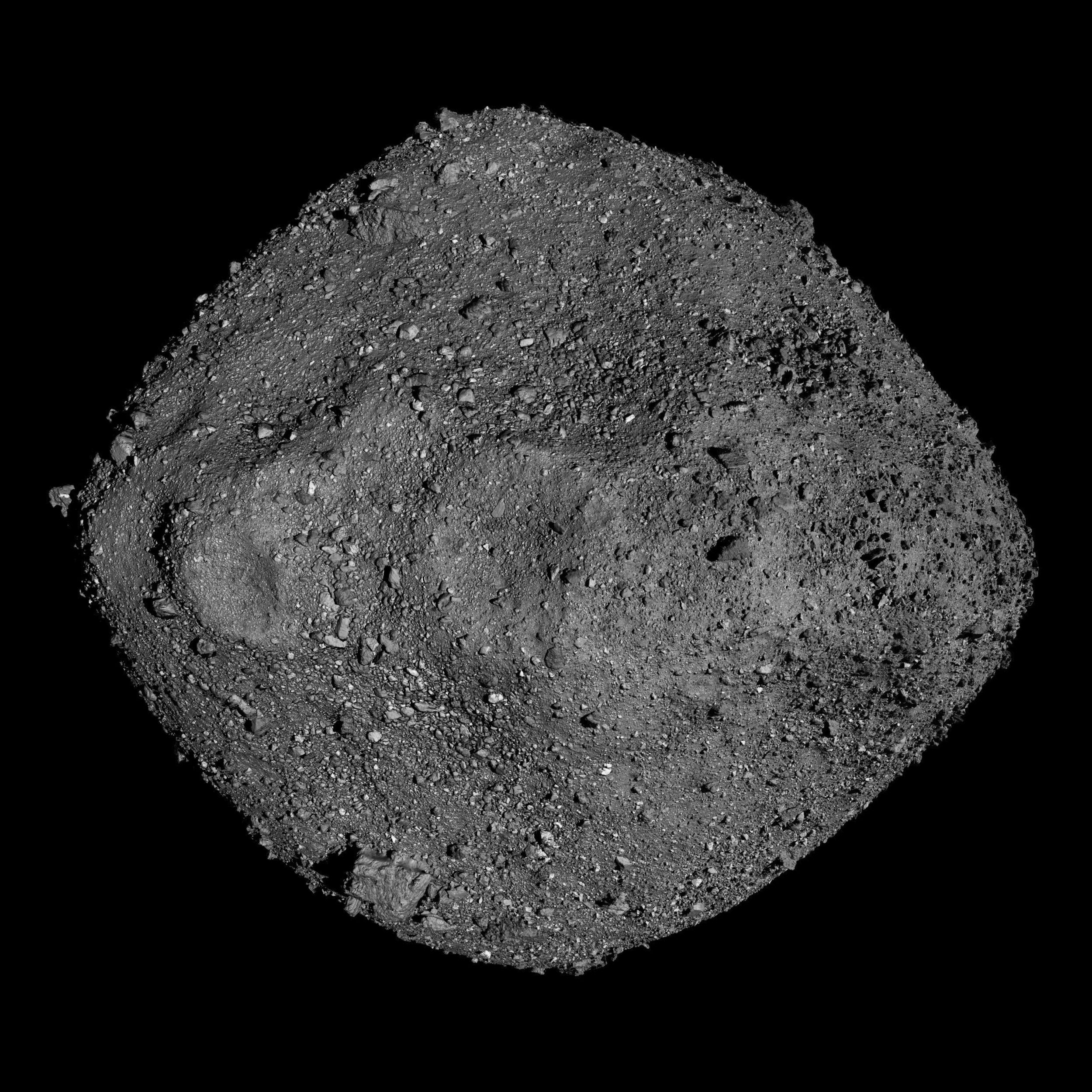

This preprint examines the preservation of ammonia in carbonaceous asteroids as a function of peak aqueous alteration temperature. Using published ammonia measurements from returned samples of asteroids (101955) Bennu (OSIRIS-REx) and (162173) Ryugu (Hayabusa2), together with representative CI, CM, and CR carbonaceous meteorites, the study identifies a strong exponential dependence of ammonia abundance on alteration temperature.
The analysis shows that relatively modest differences in peak aqueous alteration temperature (on the order of ~40–50 °C) correspond to orders-of-magnitude differences in retained ammonia. This behavior is consistent with Arrhenius-controlled diffusion and desorption kinetics governing the stabilization and release of NH₄⁺ in phyllosilicate matrices. The results indicate that peak alteration temperature, rather than alteration duration or mineralogical extent, is the dominant control on ammonia survival in primitive carbonaceous bodies.
By focusing on a minimal, empirically grounded scaling relationship derived entirely from existing measurements, this work resolves an apparent contradiction in the interpretation of volatile inventories among aqueously altered asteroids. The findings provide a predictive framework for volatile preservation, with implications for asteroid targeting, sample-return strategies, and models of reduced nitrogen delivery to the early Earth.
This research entry is timestamped and registered with the Coherence verification ledger.
View Verification Record →